Grapebreeders Home Page
Photos of Germinating Grape Seeds at Mt. Ashwabay Vineyard & Orchard - 2007
Written
by Mark Hart.
The
blotter method of seed germination is one option for starting grape
seeds. In this method seeds are put on a moist blotter, allowed to just
start to germinate, and then removed individually and put into some
kind of pot with soil or growing media. The primary advantage
over other methods is that the space and time required to pot a seed is
only performed on those seeds that actually start to grow - which may
be only be a fraction of the total seeds. As with other
germination methods, the seeds are given a moist startification (80-90
days in the refrigerator, 1 C, at MAVO); soaked for 8-24 hours in water
or dilute (3%) hydrogen peroxide; surface sterilized in laundry bleach,
diluted 4:1, for 10 minutes; and then double rinsed (with agitation) in
distilled (near sterile) water.
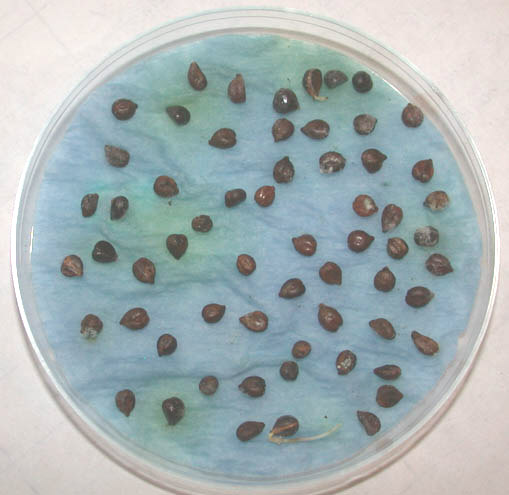
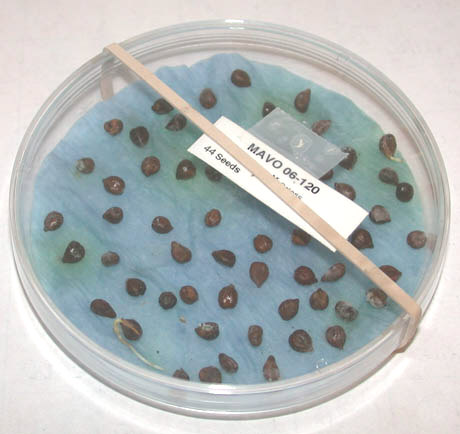
Above Photos: A moist paper blotter (Scott Contractor
Paper Towels cut to fit) in sterile disposable plastic Petri
dish. Specially made germination paper is available, but the heavy paper
towels seem to work quite well. The blotter is wetted initially to the
point just shy of there being 'free' water in the dish. The blotters
are periodically re-wetted during germination, as the blotters will
slowly dry out. Grape seeds will not all prount synchronously,
but over about a 10 day period for a seedlot. Germination dishes needed
to be checked every few days to remove the sprouted seeds, as the new
root will often start to die if it gets too big or dry in the blotter
environment.
Don't put too many seeds in a dish, the amount shown
is near the limit (no touching seeds). Notice two geminated seeds in
the photo,
ready
to plant into the plant
bands (bottomless paper pots). Seeds with a growing root (radicle)
are removed with tweezers and gently planted into the growing media.
The seed portion is positioned closest to the surface, and can be
buried to a depth of not more than 1" (1/8 to 1/4" at MAVO).
The biggest problem with this method is that fungi and mold will grow on the surface of the seeds (see photos below). The seeds should be as clean as possible before putting them in the dishes. In addition a fungicide can be used to discourage fungal growth. The active ingredient azoxystrobin has proved useful at MAVO, and mefenoxam is another good one to try. Keep the dose low, if you apply it with each re-wetting, the concentration will get higher overtime on the blotter. Techniques or chemicals that are used against damping off fungi (Pythium, Phytophthora, etc.) are good candidates to try. Be careful, some chemicals are too harsh for the very young roots - test first.
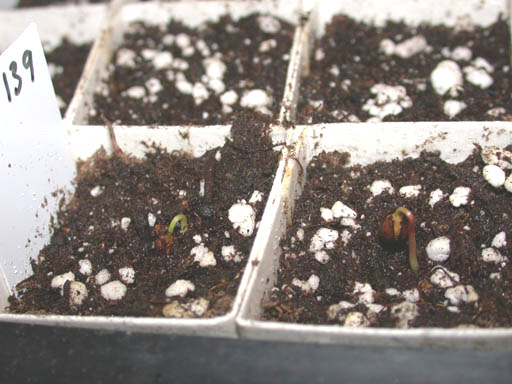
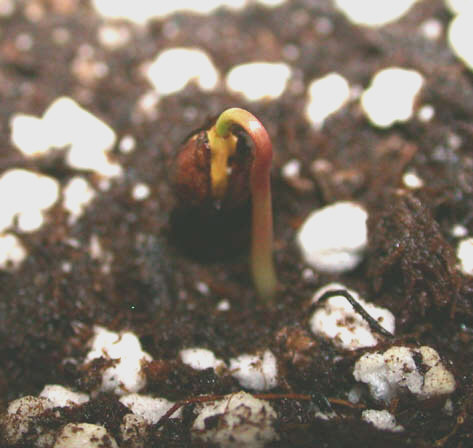
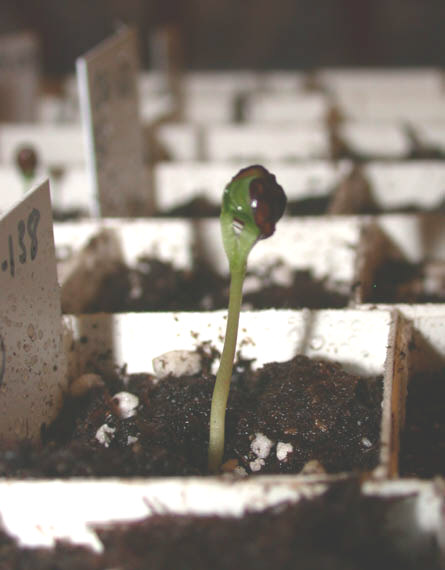
Above Photos: Seedlings emerging from the media in
the plant bands;
first the elbows, then the cotyledon leaves, which have to pull out of
the seed coat. Seedlings usually start to break through the soil
surface
about 5-8 days after being placed in the pots - depending on planting
depth and the size when transplanted from the dishes. In the
photo on the left you can see the normal 'triple split' in the seed
coat. In this photo the outer seed coat is separating well, but the
inner seed membrane (orangish in photo) is still intact. Not
infrequently the seedlings will retain the seed coat on the cotelydon
leaves for a number of days after they emerge. Usually the
seedlings will eventually get out on their own. If you try to
assist in the seed coat removal, you will often tear the very tender
leaves inside. The seedling in the photo on the right took almost
5 days to come free of its coat, which it did only moments after the
photo was taken
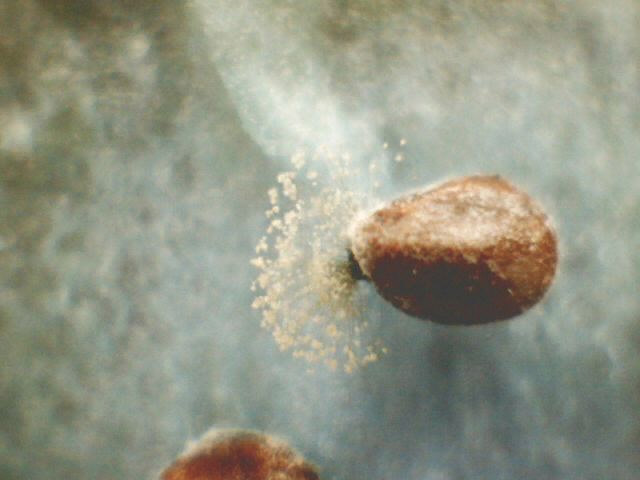
Above: A fungal 'bloom' that seems to originate from
a 'barnacle' on a grape seed. These structure are probably the fruiting
bodies of the Botrytis fungi, and the sporulation (bloom) is initiated
by being put in the moist dish environment.
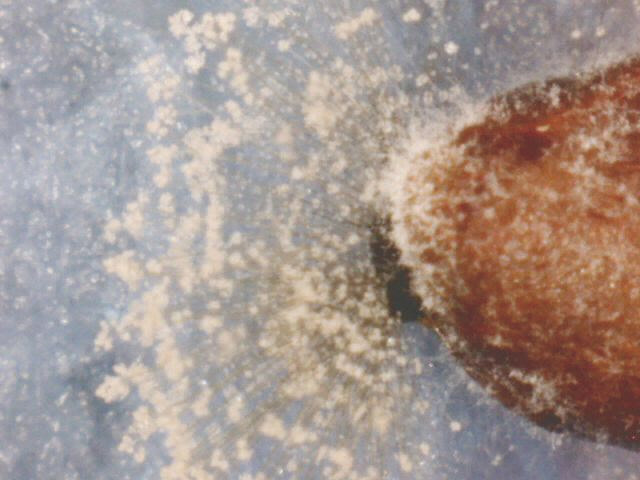
Above: A close-up of the fungal 'bloom'
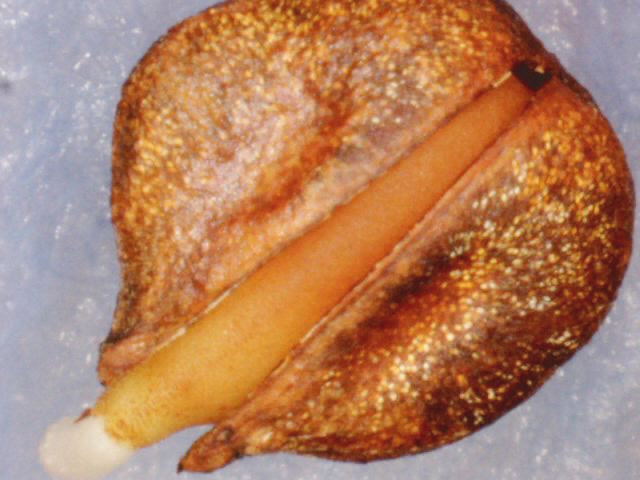
Above: A close-up of a seed that has germinated, with the root radicle growing downward (away from the camera) toward the filter paper
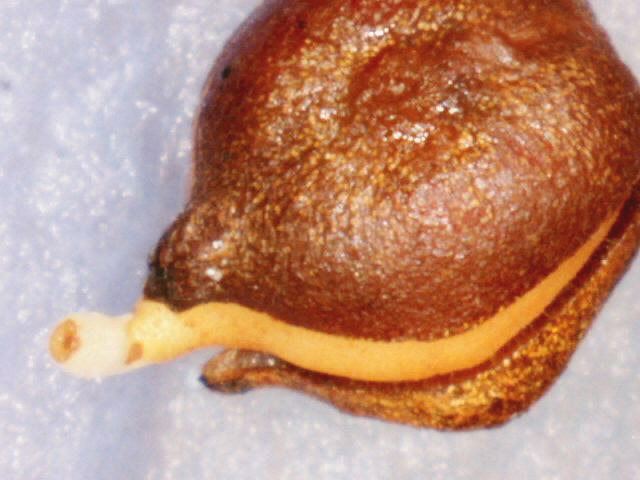
Above: A close-up of a seed that has germinated, turned over, with the root radicle pointed towards the camera.
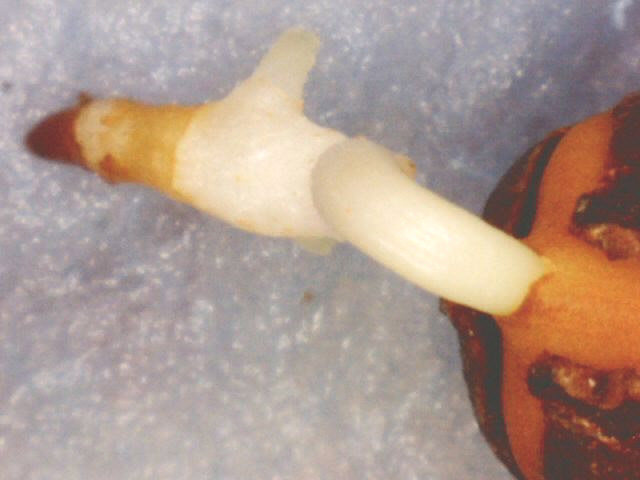
Above: A view of a longer radicle from a grape seed. In this case, the tip of the radicle was accidentally killed by exposure to a bleach surface rinse (seed started to germinate in stratification).
The radicle is showing the initiation of a branch root above the portion killed by the bleach exposure.